
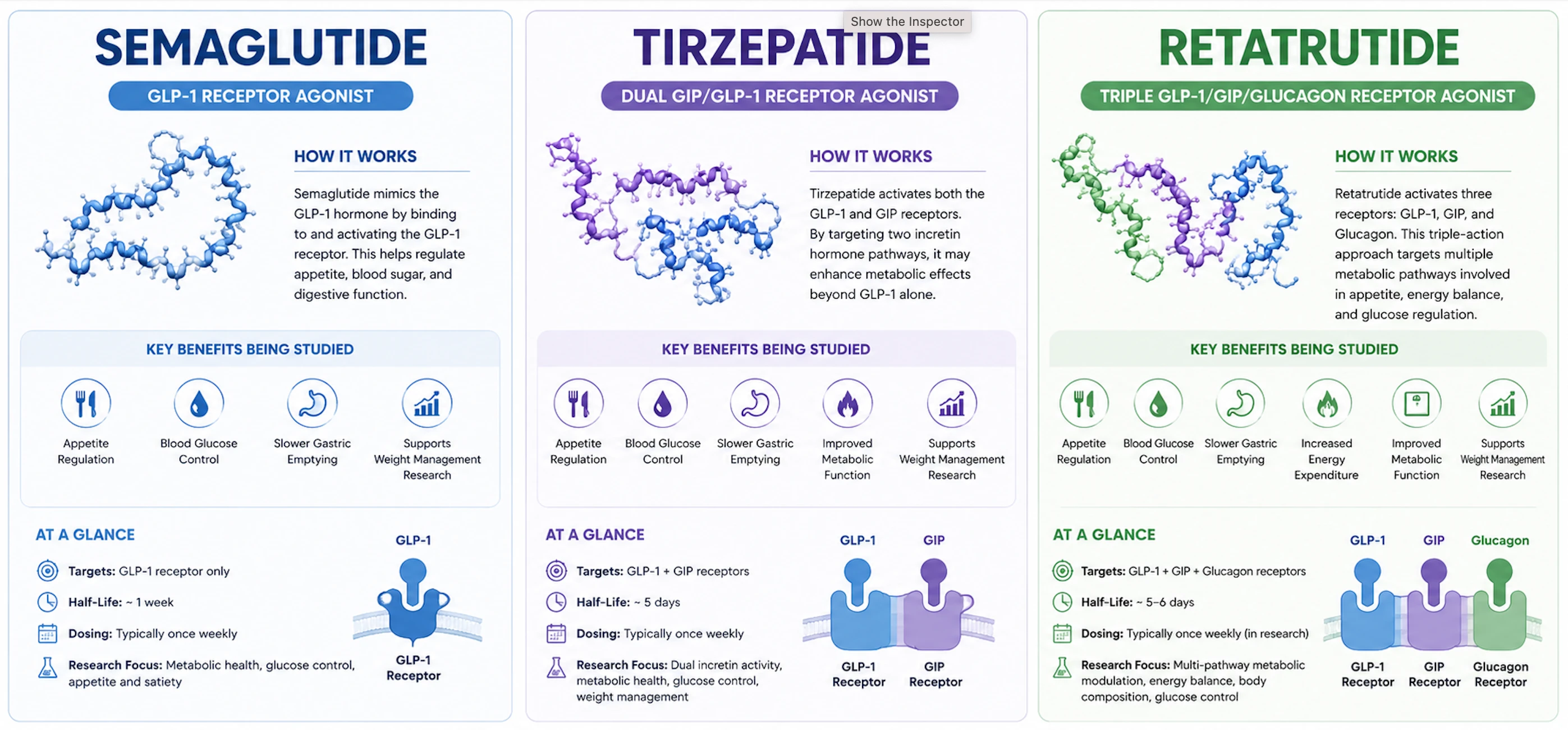
GLP-1 agonists have become one of the most talked-about areas of metabolic research in recent years. As new compounds have emerged, researchers have continued to explore how different biological pathways influence appetite regulation, energy balance and glucose metabolism.
While Semaglutide, Tirzepatide and Retatrutide are often grouped together, they are not the same. Each compound targets different receptors, which is one of the key reasons they have generated so much interest.
What Is GLP-1?
GLP-1 (Glucagon-Like Peptide-1) is a naturally occurring hormone released by the body after eating.
Researchers have found that GLP-1 signalling is involved in several important biological processes, including:
Appetite regulation
Feelings of fullness and satiety
Blood glucose regulation
Digestive function
Energy balance
GLP-1 agonists are compounds designed to mimic the activity of this natural hormone, allowing researchers to study these pathways in greater detail.
Semaglutide
Semaglutide is one of the most recognised GLP-1 agonists and has become a benchmark compound within the field.
How It Works
Semaglutide targets a single receptor:
✓ GLP-1
Why Researchers Are Interested
By focusing solely on the GLP-1 pathway, Semaglutide allows researchers to study the effects of GLP-1 receptor activation without involving additional metabolic pathways.
Potential Benefits Being Studied
Research has explored its role in:
Appetite regulation
Satiety and food intake
Glucose metabolism
Long-lasting receptor activity due to its extended half-life
In Simple Terms
Semaglutide is often viewed as the foundation of modern GLP-1 research. It demonstrated how powerful GLP-1 receptor activation could be and paved the way for the development of more advanced compounds.
Tirzepatide
Tirzepatide introduced a new approach by targeting two receptors instead of one.
How It Works
Tirzepatide activates:
✓ GLP-1
✓ GIP
Why Researchers Are Interested
GIP (Glucose-Dependent Insulinotropic Polypeptide) is another naturally occurring hormone involved in metabolic regulation.
Researchers became interested in whether combining GLP-1 and GIP activity could influence metabolic pathways differently compared to GLP-1 activation alone.
Potential Benefits Being Studied
Research has investigated:
Appetite regulation
Glucose control
Metabolic efficiency
The interaction between GLP-1 and GIP signalling pathways
In Simple Terms
If Semaglutide focuses on one pathway, Tirzepatide expands the research by activating two complementary pathways at the same time.
This dual-action approach is one of the reasons it has become such a significant focus within metabolic research.
Retatrutide
Retatrutide represents the next step in the evolution of these compounds.
How It Works
Retatrutide activates:
✓ GLP-1
✓ GIP
✓ Glucagon
Why Researchers Are Interested
In addition to GLP-1 and GIP activity, Retatrutide also targets the glucagon receptor.
The addition of a third receptor creates a unique profile that has generated significant interest among researchers investigating energy balance and metabolic function.
Potential Benefits Being Studied
Current research is exploring:
Appetite regulation
Energy expenditure
Metabolic signalling
Multi-receptor pathway interactions
Overall metabolic balance
In Simple Terms
Retatrutide builds on the foundation established by Semaglutide and Tirzepatide by introducing a third pathway into the equation.
Rather than focusing on a single receptor or two receptors, researchers are able to investigate how three interconnected pathways may work together.
This is why Retatrutide is often described as a "triple agonist" and why it has become one of the most discussed compounds currently being researched.